
Binocular Vision Assessment: A Practical Test Battery and Workflow
Updated
Written by the Optics Trainer team from published research, with every source linked below.
A binocular vision assessment brings together a handful of quick tests of alignment, convergence, vergence, accommodation, stereopsis and symptoms. Each test is simple, but the battery is most useful when the tests are done in a sensible order, read against appropriate reference values, and judged with their repeatability in mind. This guide sets out a practical workflow from published guidelines and studies, with the limits of each measure and where instrument-based testing fits.
What the battery usually includes
The American Optometric Association's guideline on accommodative and vergence dysfunction describes the core examination, and the EyeWiki convergence insufficiency page lists the signs used to identify convergence insufficiency. Together they cover:
- History, often with a symptom survey such as the Convergence Insufficiency Symptom Survey (CISS).
- Cover test at distance and near, and phoria measurement.
- Near point of convergence (NPC), with break and recovery.
- Positive and negative fusional vergence ranges, with vergence facility as a supplementary test.
- Accommodative amplitude and facility, with accommodative lag as a supplementary test.
- Stereoacuity.
Test order and technique
Order matters because some tests affect the next. The AOA guideline recommends measuring the phoria first, then divergence ranges, then convergence ranges. EyeWiki advises measuring the near deviation in reading gaze as well as primary gaze. For NPC, the AOA guideline advises recording break, recovery and any discomfort, and notes that repeating the test 4 to 5 times with a red lens over one eye can make a fragile system break down. In an adult study, Scheiman and colleagues found an accommodative target suitable and recommended the red-glass and repetition modifications when other results are equivocal.
Published reference values and where they come from
Reference values come from specific studies and populations, so they are not universal norms:
- NPC: a study of adults by Scheiman and colleagues suggested cut-offs of about 5 cm for break and 7 cm for recovery. The Convergence Insufficiency Treatment Trial (CITT) used a break of 6 cm or more as one entry criterion in children.
- CITT's entry criteria for children aged 9 to 17 combined several signs: a larger exo deviation at near than at distance, a receded NPC, reduced positive fusional vergence (failing Sheard's criterion or 15 prism dioptres or less), and a CISS score of 16 or more.
- Vergence facility: in a study of adults by Gall and colleagues, a 3 base-in/12 base-out flip prism separated symptomatic from asymptomatic adults best, with good repeatability at near and poor repeatability at distance.
- Accommodative lag: the AOA's 2010 consensus guideline gives a typical lag on monocular estimate method (MEM) retinoscopy of about +0.25 to +0.75 D, with lags over +1.00 D often seen in accommodative insufficiency or infacility. This is a consensus figure, not one derived from a single named population.
How repeatable the tests are
A single reading can be misleading. Test-retest studies show how much change is noise:
- In 20 schoolchildren, NPC was repeatable between sessions and von Graefe near phoria somewhat less so. Positive fusional vergence break typically differed by 3 to 4 prism dioptres between sessions, but differences of up to about 12 prism dioptres fell within normal test-retest variation (Rouse and colleagues, 2002).
- Negative fusional vergence was more repeatable than positive, and phoropter and prism-bar ranges should not be used interchangeably (Antona and colleagues, 2008).
- Between examiners, the modified Thorington phoria test was the most repeatable and the von Graefe the least in one adult study (Rainey and colleagues, 1998).
- For common stereotests, a change smaller than about 2 octaves may be test-retest noise (Adams and colleagues, 2009).
Which signs carry the most weight
No single test defines a binocular vision disorder. In one small case-control study of young adults (33 with symptomatic large near exophoria and 33 controls), NPC recovery and binocular accommodative facility were the most accurate single signs, which supports reading the battery as a whole rather than relying on any one result.
Symptom surveys: the CISS and its limits
The CISS distinguished symptomatic convergence insufficiency from normal binocular vision in children (cut-off 16 or more) and young adults aged 19 to 30 (cut-off 21 or more), with good test-retest reliability in adults. It is useful for tracking how a patient feels.
It is not a stand-alone measure of treatment response. In the CITT-ART trial, CISS scores improved almost as much with placebo therapy (10.4 points) as with active therapy (11.8 points), while NPC and especially positive fusional vergence improved more with active therapy. The investigators cautioned against judging success on the symptom survey alone.
Where instrument-based testing fits
Eye tracking is used widely in optometry research, mainly for fixation, saccades, pursuits and pupil measures, and a 2023 systematic review noted that many studies report their methods incompletely. The evidence for eye-tracked and VR versions of the Hess-Lancaster test is small. In 13 adults without binocular problems, an eye-tracked version differed significantly from manual measurements horizontally (correlations about 0.4 to 0.5) and showed essentially no correlation vertically. A VR version in 52 adults with suspected or diagnosed motility disorders showed only moderate agreement with the conventional test. Their authors present these methods as complements to the full examination. A 2026 scoping review of eye tracking for paediatric binocular vision assessment found only 14 eligible studies published from 2015 to 2025.
Instrument-based tests can add recorded, repeatable data and visual reports, but the evidence so far supports using them alongside the standard battery, not instead of it.
How Optics Tracker fits into the workflow
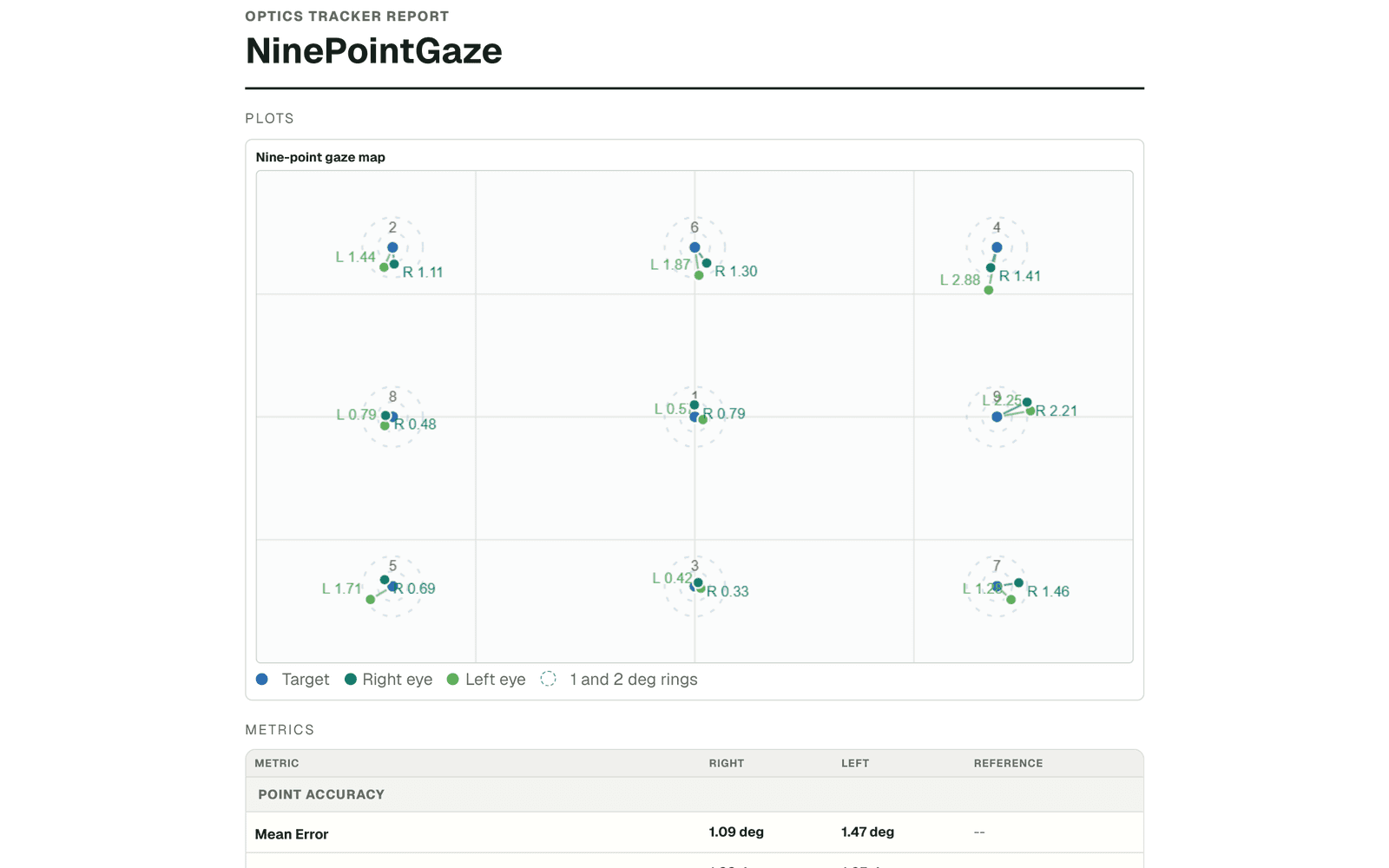
Optics Tracker includes alignment and sensory tests (nine-point gaze, Worth 4 Dot and Hess), eye-movement tests, and binocular disparity plots, and Optics Trainer VR includes vergence and stereo activities. These can sit alongside the standard battery in a clinic's workflow.
Optics Tracker is clinical decision-support software. Its results support, and do not replace, the clinical tests above, professional diagnosis and clinical judgement.
Frequently asked questions
What tests are included in a binocular vision assessment?
Typically history and a symptom survey, cover test and phoria, near point of convergence, fusional vergence ranges and vergence facility, accommodative amplitude, facility and lag, stereoacuity, and suppression tests where indicated.
What is a normal near point of convergence?
There is no single universal value. One adult study suggested about 5 cm for break and 7 cm for recovery, and the CITT trial used a break of 6 cm or more as one criterion for convergence insufficiency in children. Use reference values from studies of comparable patients.
How reliable are fusional vergence measurements?
Less reliable than many clinicians assume. In a study of 20 schoolchildren, positive fusional vergence break typically differed by 3 to 4 prism dioptres between sessions, and differences of up to about 12 fell within normal test-retest variation, and phoropter and prism-bar ranges should not be used interchangeably.
Can the CISS diagnose convergence insufficiency?
Not on its own. It separates symptomatic convergence insufficiency from normal binocular vision as part of a diagnosis based on several signs, and in CITT-ART it improved almost as much with placebo as with active therapy.
Sources
- American Optometric Association. Optometric Clinical Practice Guideline: Care of the Patient with Accommodative and Vergence Dysfunction
- EyeWiki (American Academy of Ophthalmology). Convergence insufficiency
- Convergence Insufficiency Treatment Trial Study Group. Randomized clinical trial of treatments for symptomatic convergence insufficiency in children. Arch Ophthalmol. 2008;126(10):1336–1349
- CITT-ART Investigator Group. Treatment of symptomatic convergence insufficiency in children enrolled in the Convergence Insufficiency Treatment Trial–Attention & Reading Trial: a randomized clinical trial. Optom Vis Sci. 2019;96(11):825–835
- Rouse MW, Borsting EJ, Mitchell GL, et al. Validity and reliability of the revised convergence insufficiency symptom survey in adults. Ophthalmic Physiol Opt. 2004;24(5):384–390
- Rouse M, Borsting E, Mitchell GL, et al. Validity of the convergence insufficiency symptom survey: a confirmatory study. Optom Vis Sci. 2009;86(4):357–363
- Scheiman M, Gallaway M, Frantz KA, et al. Nearpoint of convergence: test procedure, target selection, and normative data. Optom Vis Sci. 2003;80(3):214–225
- Gall R, Wick B, Bedell H. Vergence facility: establishing clinical utility. Optom Vis Sci. 1998;75(10):731–742
- Rouse MW, Borsting E, Deland PN; CIRS Group. Reliability of binocular vision measurements used in the classification of convergence insufficiency. Optom Vis Sci. 2002;79(4):254–264
- Antona B, Barrio A, Barra F, et al. Repeatability and agreement in the measurement of horizontal fusional vergences. Ophthalmic Physiol Opt. 2008;28(5):475–491
- Rainey BB, Schroeder TL, Goss DA, Grosvenor TP. Inter-examiner repeatability of heterophoria tests. Optom Vis Sci. 1998;75(10):719–726
- Adams WE, Leske DA, Hatt SR, Holmes JM. Defining real change in measures of stereoacuity. Ophthalmology. 2009;116(2):281–285
- Cacho-Martínez P, García-Muñoz Á, Ruiz-Cantero MT. Diagnostic validity of clinical signs associated with a large exophoria at near. J Ophthalmol. 2013;2013:549435
- González-Vides L, Hernández-Verdejo JL, Cañadas-Suárez P. Eye tracking in optometry: a systematic review. J Eye Mov Res. 2023;16(3):3
- Orduna-Hospital E, Maurain-Orera L, Lopez-de-la-Fuente C, Sanchez-Cano A. Hess Lancaster screen test with eye tracker: an objective method for the measurement of binocular gaze direction. Life (Basel). 2023;13(3):668
- Povedano-Montero FJ, et al. Conventional versus virtual reality-based Hess-Lancaster assessment: agreement and repeatability in ocular motility evaluation. J Eye Mov Res. 2026;19(3):67
- Koon OH, Badarudin NE, Chu BS. Application of eye-tracking technology in assessing binocular vision function in paediatric populations: a scoping review. J Eye Mov Res. 2026;19(2):40
See it in Optics Tracker
Related articles
- Video Games and VR for Convergence Insufficiency: What the Trials Show
- Saccades, Pursuits and Fixation: What Objective Eye-Movement Testing Measures
- Red/Blue and Red/Green Glasses in Vision Therapy: MFBF, Anti-Suppression and the Evidence
- Fusional Vergence Ranges and Vergence Facility: Measurement and Limits
- Stereoacuity Tests Compared: Randot, TNO, Titmus, Frisby, Digital and VR