
Saccades, Pursuits and Fixation: What Objective Eye-Movement Testing Measures
Updated
Written by the Optics Trainer team from published research, with every source linked below.
Saccades, smooth pursuit and fixation are core eye-movement skills checked in a binocular vision or oculomotor exam. Traditionally they are judged by watching the patient follow a target. An eye tracker records the same movements as numbers and traces. This guide explains what each measure means, how recorded results relate to observational tests such as the NSUCO, how the measures change as children grow, and what affects the quality of eye-tracking data.
Saccades: latency, velocity and accuracy
Saccades are the fast jumps that move the eyes from one point to another. Recorded saccades are usually described by three measures: latency (how long the eyes take to start moving after the target appears), peak velocity, and accuracy or gain (where the eyes land relative to the target). A saccade that falls short is hypometric and may be followed by a small corrective saccade.
Peak velocity rises with the size of the saccade and then levels off, and saccade duration grows with amplitude. This relationship is called the main sequence. Tiny saccades made during fixation, microsaccades, follow the same relationship.
Smooth pursuit: gain and catch-up saccades
Smooth pursuit keeps a moving target on the fovea. Pursuit is usually summarised by gain, the eye's velocity divided by the target's velocity. When the eyes fall behind, they make catch-up saccades. Studies usually score those separately, so gain reflects the smooth pursuit system itself rather than the total movement.
Pursuit depends on both predicting where the target is going and visual feedback about where it is. Target speed matters: in a study of school-age children, faster targets produced more saccades during pursuit, and vertical pursuit gain was generally lower than horizontal.
Fixation stability
Fixation is never perfectly still. Even when someone looks steadily at one point, the eyes drift slowly, show a fine tremor, and make occasional microsaccades. "Fixation stability" can therefore mean two different things: the movement within a single fixation, or the scatter of fixation positions over time.
The bivariate contour ellipse area (BCEA) is the most common summary of fixation stability in optometry research. It assumes eye positions are normally distributed, and computing it from raw samples rather than fixation means can give significantly different values, so results are only comparable when the method is the same.
Observation versus recording
Observational tests such as the NSUCO oculomotor test, developed by Maples and Ficklin, grade pursuits and saccades on ability, accuracy and head or body movement from the examiner's judgement, and in their 1988 report the authors judged its interrater and test-retest reliability clinically acceptable. They are quick and need no equipment.
Recording adds measures an examiner cannot see, such as latency, velocity and gain, and can pick up small errors: a review of saccades in movement disorders notes that, in Parkinson's disease, some hypometric saccades may need eye-movement recording to detect. In a 2025 pilot study of 47 children, NSUCO saccade scores correlated moderately with hypometric saccades and regressions counted by a 60 Hz eye tracker. That shows the two methods agree in part, not that one can replace the other.
How the measures change with age
Children's eye movements are still developing, so results must be read against age:
- Saccade latency shortens through childhood and into adolescence. In one study of 39 participants aged 8 to 19, gain and peak velocity of visually guided saccades did not change with age and were similar to previously reported adult values.
- Pursuit gain improves through childhood. One child-friendly study found horizontal pursuit was adult-like by about 7 to 8 years, while other studies report pursuit still maturing into adolescence.
- Fixation stability improves from early childhood into adolescence, with fewer intruding saccades.
- Children's eye-movement data are more variable than adults', and attention and fatigue can strongly affect pursuit.
Binocular coordination during eye movements
The two eyes are not perfectly yoked during saccades. In a laboratory study of three adults using scleral search coils, the abducting eye's saccade was larger and faster than the adducting eye's, the eyes briefly diverged, and both version and vergence drift followed the saccade. In a study of 8 seven-year-olds and 8 adults, saccade disconjugacy and post-saccadic drift were larger in the children. Binocular recordings make these differences visible, and some disconjugacy was found in every typical observer in these studies.
What affects eye-tracking data quality
"Objective" does not automatically mean accurate. Eye-tracking data quality has three separate parts: accuracy (the offset between where the person looks and the reported gaze), precision (sample-to-sample variation during steady gaze) and data loss (time with no gaze reported).
Manufacturers' accuracy figures are typically obtained under ideal conditions with a chinrest. Niehorster and colleagues found that unrestrained or awkward head positions degrade accuracy and increase data loss on screen-based trackers, by amounts that differed between systems, and that headset slippage can add gaze error on some head-worn trackers. A 2023 systematic review of eye tracking in optometry (141 reports) found many studies under-reported calibration accuracy and data loss. These findings suggest some practical checks:
- Calibrate at the start of each session, and recalibrate if a head-worn tracker shifts.
- Keep viewing distance and head position as consistent as possible.
- Check data loss before interpreting a trace.
- When comparing over time, keep the test and setup the same.
How Optics Tracker records these movements
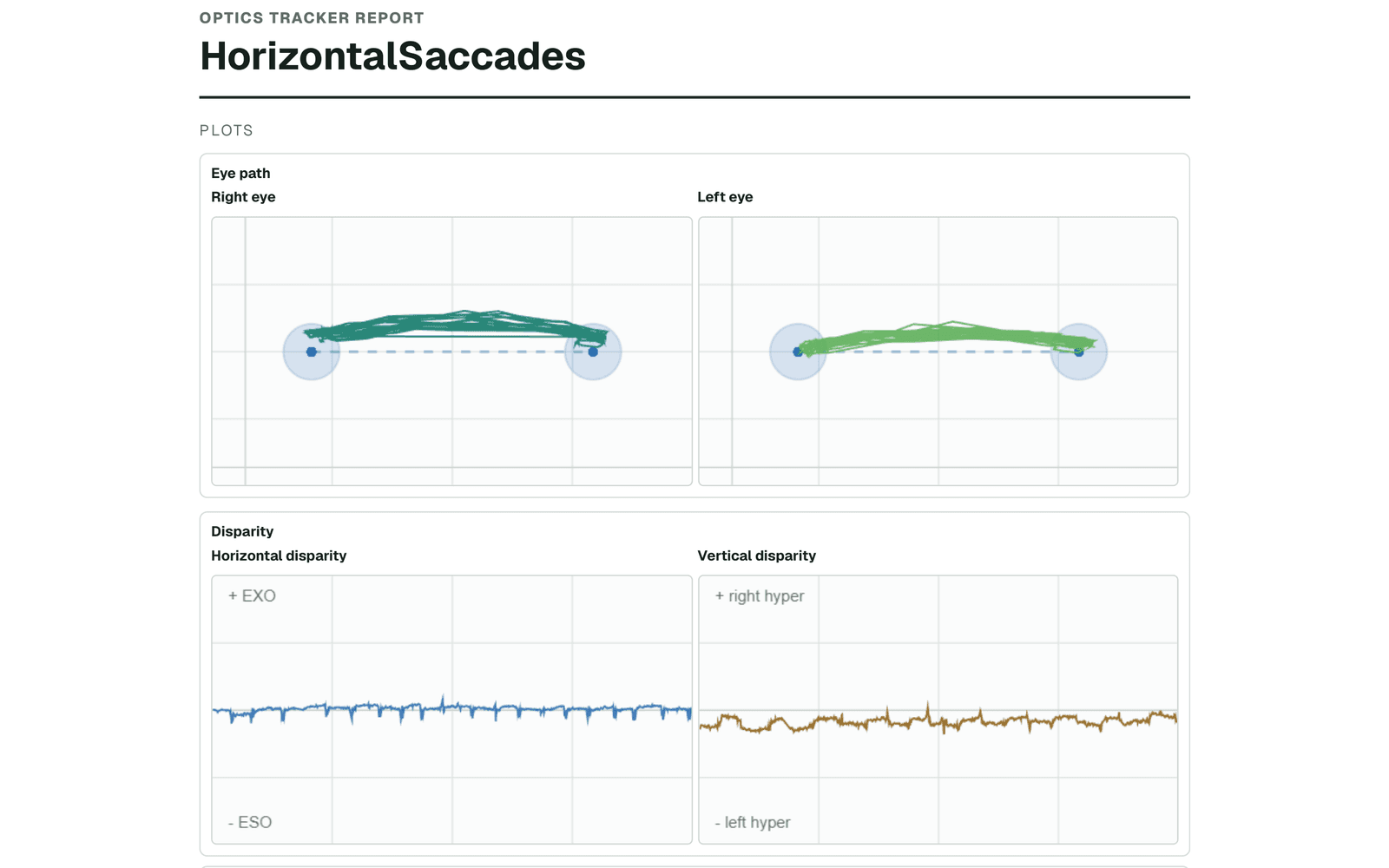
Optics Tracker includes pursuit paths (horizontal, vertical, circular, diagonal, box and figure-eight), horizontal and vertical saccades, and static fixation and VOR tests. Reports show left and right eye paths with horizontal and vertical disparity plots.
Optics Tracker is clinical decision-support software. Its recordings describe eye movements and support, rather than replace, professional diagnosis and clinical judgement.
Frequently asked questions
What does a saccade test measure?
A recorded saccade test measures latency (time to start moving), peak velocity, and accuracy or gain (where the eyes land relative to the target), plus corrective saccades after undershoots.
What is pursuit gain?
Pursuit gain is eye velocity divided by target velocity during smooth pursuit. Catch-up saccades are usually scored separately, so gain describes the smooth tracking itself.
How is fixation stability measured?
In optometry research, most often with the bivariate contour ellipse area (BCEA), which summarises the scatter of eye positions during fixation. The way it is computed changes the result, so compare values only when the method is the same.
Is eye tracking better than the NSUCO test?
They measure different things. The NSUCO grades movements by observation, while recording gives measures such as latency and gain and can show small errors, such as slightly short saccades, that may be hard to see by eye. In one small study the two correlated moderately, which suggests they complement rather than replace each other.
At what age do eye movements mature?
It depends on the measure. Saccade latency keeps shortening into adolescence, pursuit gain improves through childhood with studies disagreeing on when it reaches adult levels, and fixation stability improves into adolescence.
Sources
- González-Vides L, Hernández-Verdejo JL, Cañadas-Suárez P. Eye tracking in optometry: a systematic review. J Eye Mov Res. 2023;16(3):3
- Maples WC, Ficklin TW. Interrater and test-retest reliability of pursuits and saccades. J Am Optom Assoc. 1988;59(7):549–552
- Bilbao C, et al. Saccadic eye movements in childhood: a pilot study comparing clinical eye tracker software and the NSUCO. J Optom. 2025;18(4):100565
- Termsarasab P, Thammongkolchai T, Rucker JC, Frucht SJ. The diagnostic value of saccades in movement disorder patients: a practical guide and review. J Clin Mov Disord. 2015;2:14
- Luna B, Velanova K, Geier CF. Development of eye-movement control. Brain Cogn. 2008;68(3):293–308
- Salman MS, et al. Saccades in children. Vision Res. 2006;46(8–9):1432–1439
- Vinuela-Navarro V, Erichsen JT, Williams C, Woodhouse JM. Quantitative characterization of smooth pursuit eye movements in school-age children using a child-friendly setup. Transl Vis Sci Technol. 2019;8(5):8
- Katsanis J, Iacono WG, Harris M. Development of oculomotor functioning in preadolescence, adolescence, and adulthood. Psychophysiology. 1998;35(1):64–72
- Lencer R, Trillenberg P. Neurophysiology and neuroanatomy of smooth pursuit in humans. Brain Cogn. 2008;68(3):219–228
- Collewijn H, Erkelens CJ, Steinman RM. Binocular co-ordination of human horizontal saccadic eye movements. J Physiol. 1988;404:157–182
- Bucci MP, Kapoula Z. Binocular coordination of saccades in 7 years old children in single word reading and target fixation. Vision Res. 2006;46(4):457–466
- Castet E, Crossland M. Quantifying eye stability during a fixation task: a review of definitions and methods. Seeing Perceiving. 2012;25(5):449–469
- Rucci M, Poletti M. Control and functions of fixational eye movements. Annu Rev Vis Sci. 2015;1:499–518
- Niehorster DC, et al. What to expect from your remote eye-tracker when participants are unrestrained. Behav Res Methods. 2018;50(1):213–227
- Niehorster DC, et al. The impact of slippage on the data quality of head-worn eye trackers. Behav Res Methods. 2020;52(3):1140–1160
See it in Optics Tracker
Related articles
- Reading Eye Tracking: What Eye Movement Recordings Show During Reading
- The DEM Test: How It Works, How It's Scored, and What the Research Says
- Binocular Vision Assessment: A Practical Test Battery and Workflow
- Visual Reaction Time Testing: What It Measures and Its Limits
- Gaze Stability and the VOR: What Clinic Testing Measures
- Clinical Eye-Tracking Systems for Eye Care: A Factual Comparison (October 2026)