The DEM Test: How It Works, How It's Scored, and What the Research Says
Updated
Written by the Optics Trainer team from published research, with every source linked below.
The Developmental Eye Movement (DEM) Test™ is a timed number-naming test that eye care clinicians use to look at visual-verbal performance in children. It is quick to give, needs only the test kit and a stopwatch, and is widely used in optometric practice. This guide explains how the DEM is given and scored, how to read the four result patterns, how reliable the scores are on retest, what research says the test actually measures, and why the norms you use matter.
What the DEM test is
Ralph Garzia, Jack Richman and colleagues introduced the DEM in 1990. Their aim was to separate how automatically a child names numbers from how well the eyes move across a line, a distinction earlier visual-verbal tests did not make. The original paper reported norms for children aged 6 to 13. The test is sold by Bernell, which describes it as a method for assessing fixational and saccadic activity in reading and non-reading tasks.
The DEM Test™ is licensed from Bernell. The test plates, examiner's manual, norms tables and scoring rules are supplied by Bernell, and this guide does not reproduce them.
How the DEM test is given
The patient names numbers aloud, as quickly and accurately as possible, from a series of plates:
- Pretest: a short horizontal row of numbers that checks basic number naming before timing begins.
- Tests A and B: numbers arranged in vertical columns. Reading down a column needs little horizontal eye movement, so these times mainly reflect naming speed.
- Test C: the same 80 numbers arranged in horizontal rows, like text. Its time reflects naming plus the eye movements needed to move along and between the rows.
How the DEM test is scored
The DEM produces four scores, each compared with age norms, usually as percentiles:
- Vertical time: the Test A time plus the Test B time.
- Adjusted horizontal time: the Test C time corrected for numbers the patient skipped (omissions) or added (additions). Published studies apply the correction as Test C time × 80 ÷ (80 − omissions + additions).
- Ratio: adjusted horizontal time divided by vertical time. It is the score intended to separate a horizontal, oculomotor difficulty from slow naming.
- Errors: the total errors on Test C, counted under the rules in the examiner's manual.
Reading the four DEM result patterns
Comparing the vertical time, horizontal time and ratio with their norms gives four broad patterns, as described in Alessio Facchin's 2021 review of the test:
- All scores within norms: normal performance.
- Slow vertical and horizontal times with a normal ratio: a naming or automaticity pattern.
- Normal vertical time with a slow horizontal time and a high ratio: an oculomotor pattern.
- Slow times and a high ratio: a combined pattern.
Reliability and retesting
The times repeat better than the ratio. In a 2004 study of 30 third-grade children retested after two weeks, Rouse and colleagues found fair-to-good repeatability for vertical and corrected horizontal times (intraclass correlations of 0.60 and 0.55), but poor repeatability for the ratio (0.27). All three scores improved on retest, and the authors warned that large changes on retest can change a child's classification, for example from pass to fail.
Facchin and Maffioletti's larger 2018 study of 115 Italian children in grades 2 to 5 found higher reliability: about 0.93 for vertical time, 0.89 for adjusted horizontal time, 0.65 for the ratio and 0.69 for errors, with a smaller learning effect. Facchin's review notes that studies advise comparing a patient with their own baseline and allowing for the learning effect when judging change.
What the DEM actually measures
Several studies question whether the DEM measures saccades. In 158 children aged 8 to 11, Ayton and colleagues found that no DEM score correlated with saccade gain, latency, peak velocity or corrective saccades recorded on an infrared eye tracker, although DEM results did correlate with reading performance and visual processing speed. Those saccades were recorded on separate tasks, not during the DEM.
Tanke and colleagues recorded eye movements during a digital version of the DEM in healthy children. Saccade number, amplitude and direction correlated with horizontal performance, but saccades took up little of the test time, which was dominated by fixating and naming. Fixation duration tracked visual processing speed, and the authors concluded that the DEM is not suitable for measuring saccade behaviour, though it may index visual-verbal naming and processing speed. A follow-up study of children with visual impairment found that nystagmus did not raise the ratio.
One study has looked at adults with chronic mild traumatic brain injury. In 85 military service members, those with diagnosed oculomotor dysfunction had longer vertical and adjusted horizontal times, but their ratio did not differ. It was a single-centre retrospective study.
DEM norms across languages and ages
Whether a population matches the original English-language norms is a question each study has to answer. Some did not match:
- Cantonese-speaking children in Hong Kong (305 children aged 6 to 11) were faster than the English and Spanish norms at every age.
- Mandarin-speaking children in Nanjing (1,425 children aged 5 to 12) were much faster than the English and Spanish norms.
- Portuguese children (695 children aged 6 to 13) were slower at younger ages. Judged against US norms, this normal sample would have shown an unusually large number of apparent problems, so the authors called for Portuguese norms.
- Hebrew-speaking children (224 aged 6 to 13) scored close to the original norms. For French-speaking children the evidence is mixed: a 2020 study of 327 children found scores similar to the American norms, while a 2026 study of 1,059 children found significant differences and published French-specific norms.
- Adult norms have been published for 521 Italian adults aged 20 to 79. DEM times lengthened with age.
The DEM and reading difficulties
Naming numbers is not reading, and Facchin's 2021 review argued that the DEM cannot detect reading problems. A 2026 study of 1,059 French schoolchildren by Vernet and colleagues found that DEM scores correlated with reading performance and were highly sensitive in identifying children at risk of reading difficulties, and the authors proposed the DEM as an early screening tool. A screening result is a reason for a reading and language assessment, not a diagnosis. In a study of 59 children, Webber and colleagues found that slower DEM times went with slower reading rates, but once reading ability was taken into account, DEM scores no longer predicted reading rate, and they were not associated with standardised reading scores.
In a pilot study with eye movement recordings, Moiroud and colleagues found that children with dyslexia and younger children matched for reading level both had slower Test C times and longer fixations than children of the same age. In this small pilot, with 13 children per group, a slow Test C time tracked reading level rather than identifying dyslexia.
What eye tracking adds to the DEM
A stopwatch gives one time per plate. Recording eye movements during the test, as Moiroud (Test C) and Tanke (a digital DEM) did, shows how that time was spent, such as the number and duration of fixations and the number and size of saccades. These details can help a clinician see what lies behind a slow time, though they have not been validated for that purpose.
Published DEM norms apply to the stopwatch scores. We are not aware of published norms or validation for eye-movement measures recorded during the DEM, so treat them as descriptive information alongside the standard scores.
How Optics Tracker runs the DEM
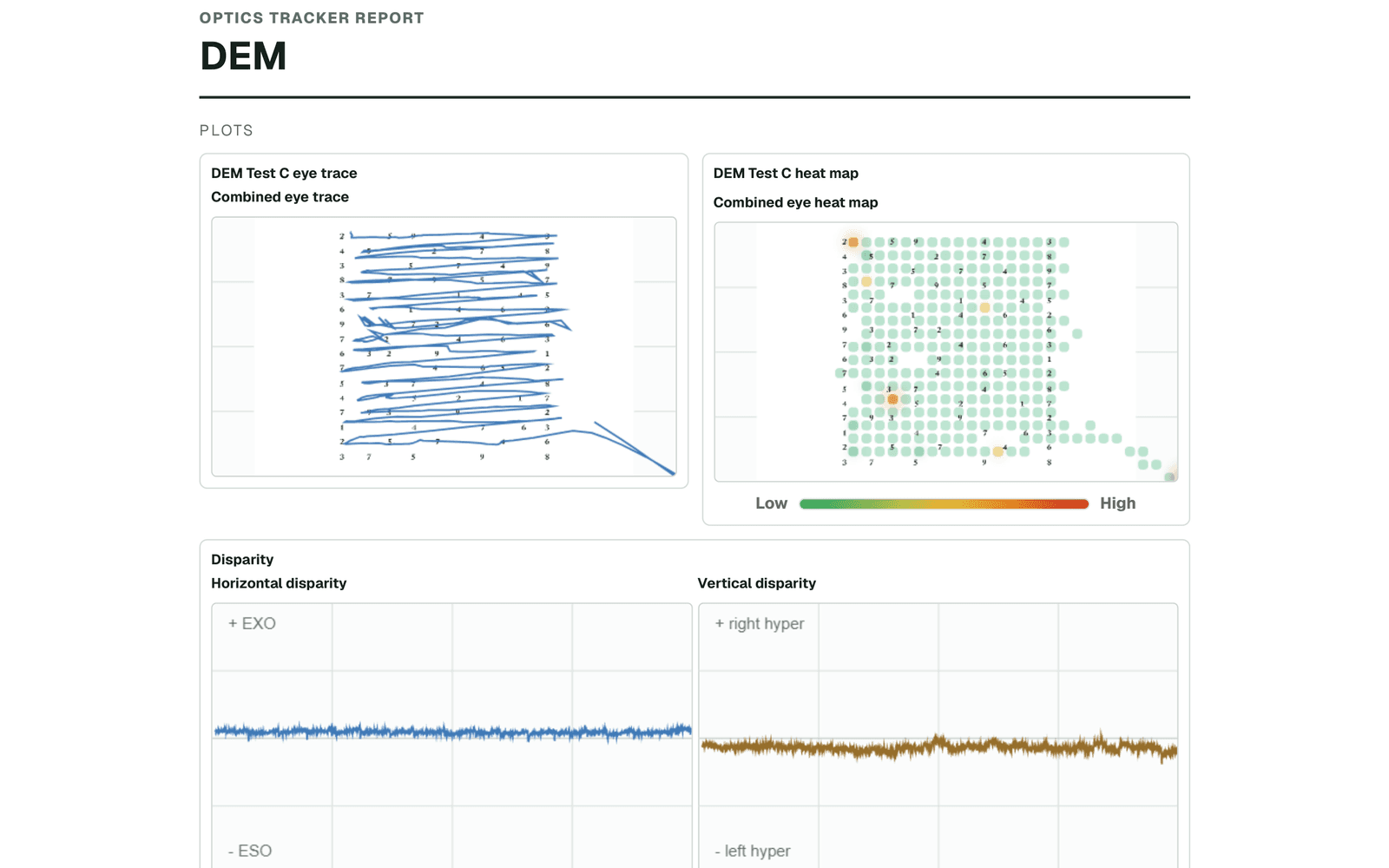
Optics Tracker includes a guided Developmental Eye Movement (DEM) Test™ workflow, licensed from Bernell and currently in beta, that covers the pretest and Tests A, B and C. It records the patient's speech during Test C and recognises the spoken digits, detects addition, omission, transposition and substitution errors for the clinician to review and correct, and calculates vertical time, horizontal time, the ratio and total errors with an age-based norm comparison. It also records eye movements during Test C and reports a gaze replay, heat map, fixations, fixation duration, saccades, regressions and binocular disparity.
The DEM is an optional add-on subscription, not included in the base Optics Tracker subscription. Optics Tracker is clinical decision-support software, and its reports support, rather than replace, professional diagnosis and clinical judgement.
Frequently asked questions
What does the DEM test measure?
It times how quickly a patient names numbers in vertical columns and in horizontal rows. Comparing the two separates naming speed from the extra time needed along horizontal lines. Studies with eye tracking suggest the scores mainly reflect visual-verbal naming and processing speed rather than saccades themselves.
How do you calculate the DEM ratio?
Divide the adjusted horizontal time by the vertical time. The adjusted horizontal time is the Test C time corrected for omissions and additions, which published studies calculate as Test C time × 80 ÷ (80 − omissions + additions).
What age is the DEM test for?
The original 1990 norms covered children aged 6 to 13, and most published norms are for school-age children. Adult norms have since been published for Italian speakers, but use the norms that match your patient's age and language.
What are the DEM result types?
Results are commonly grouped into four patterns: all scores normal; slow vertical and horizontal times with a normal ratio (naming); a normal vertical time with a slow horizontal time and high ratio (oculomotor); and slow times with a high ratio (combined).
Is the DEM reliable for retesting?
The vertical and horizontal times repeat reasonably well, but the ratio is less reliable, and scores tend to improve on a second attempt. Compare a patient with their own baseline and allow for this learning effect.
Can the DEM test diagnose dyslexia?
No. The DEM does not test reading directly, and in one study children with dyslexia performed like younger children of the same reading level. A 2026 French study found it sensitive as a screen for children at risk of reading difficulties, but a positive screen calls for a reading and language assessment. It does not identify dyslexia or a learning disability.
Sources
- Garzia RP, Richman JE, Nicholson SB, Gaines CS. A new visual-verbal saccade test: the Developmental Eye Movement test (DEM). J Am Optom Assoc. 1990;61(2):124–135
- Bernell. Developmental Eye Movement Test (DEM), product page
- Facchin A. Spotlight on the Developmental Eye Movement (DEM) Test. Clin Optom (Auckl). 2021;13:73–81
- Rouse MW, Nestor EM, Parot CJ, DeLand PN. A reevaluation of the Developmental Eye Movement (DEM) test's repeatability. Optom Vis Sci. 2004;81(12):934–938
- Facchin A, Maffioletti S. The reliability of the DEM test in the clinical environment. Front Psychol. 2018;9:1279
- Ayton LN, Abel LA, Fricke TR, McBrien NA. Developmental eye movement test: what is it really measuring? Optom Vis Sci. 2009;86(6):722–730
- Tanke N, Barsingerhorn AD, Boonstra FN, Goossens J. Visual fixations rather than saccades dominate the developmental eye movement test. Sci Rep. 2021;11:1162
- Tanke N, et al. The Developmental Eye Movement test does not detect oculomotor problems: evidence from children with nystagmus. Optom Vis Sci. 2022;99(9):711–717
- Hu C, Girdher G, DeGraba TJ, Meier K. Developmental eye movement test performance and oculomotor dysfunction in adults with chronic mild traumatic brain injury. Brain Inj. 2026:1–8
- Pang PC, Lam CS, Woo GC. The Developmental Eye Movement (DEM) test and Cantonese-speaking children in Hong Kong SAR, China. Clin Exp Optom. 2010;93(4):213–223
- Xie Y, Shi C, Tong M, et al. Developmental Eye Movement (DEM) test norms for Mandarin Chinese-speaking Chinese children. PLoS One. 2016;11(2):e0148481
- Baptista AM, et al. Norms for the developmental eye movement test for Portuguese children. Optom Vis Sci. 2011;88(7):864–871
- Moiroud L, Royo A, Bucci MP. The Developmental Eye Movement test in French children. Optom Vis Sci. 2020;97(11):978–983
- Ben-Eli H, Blique H, Scheiman M, Eichler R. Developmental eye movement test results of Hebrew-speaking children with cross-linguistic comparisons. Ophthalmic Physiol Opt. 2025;45(1):43–49
- Facchin A, Maffioletti S, Daini R. Developmental Eye Movement (DEM) Test in Adults: Age-Related Changes and Italian Normative Data. Vision (Basel). 2025;9(1):10
- Vernet M, Jover M, Bellocchi S, Chaix Y, Ducrot S. The Developmental Eye Movement Test as a Screening Tool for Reading Difficulties: Insights From a Large-Scale Study in French Schoolchildren. Percept Mot Skills. 2026
- Webber A, Wood J, Gole G, Brown B. DEM test, Visagraph eye movement recordings, and reading ability in children. Optom Vis Sci. 2011;88(2):295–302
- Moiroud L, Gerard CL, Peyre H, Bucci MP. Developmental Eye Movement test and dyslexic children: a pilot study with eye movement recordings. PLoS One. 2018;13(9):e0200907
See it in Optics Tracker