Reading Eye Tracking: What Eye Movement Recordings Show During Reading
Updated
Written by the Optics Trainer team from published research, with every source linked below.
A reading eye tracking test records where each eye points, many times a second, while a patient reads a passage. The result is a trace of every pause and jump across the text, which a clinician can replay and measure instead of judging by watching. This guide explains what those recordings contain, what eye movement research says typical reading looks like in adults and children, how to read return sweeps and binocular disparity, and where the evidence sets limits on what a recording can tell you.
What a reading eye tracking test records
Reading is not a smooth sweep along the line. The eyes stop on a word, jump forward, sometimes jump back, and at the end of the line make a long jump to the start of the next one. An eye tracker records each of these events for each eye, so the raw recording can be broken into a small set of measurable parts:
- Fixations: the pauses during which the reader takes in text, measured by count and duration.
- Saccades: the fast forward jumps between fixations, measured in letter spaces or degrees.
- Regressions: saccades that move backwards in the text, usually to the word just read.
- Return sweeps: the long saccades from the end of one line to the start of the next.
- Binocular measures: the difference in where the two eyes point (disparity) and how closely they move together.
- Rate and comprehension: words per minute, plus a short comprehension check so that speed is not reported without understanding.
What typical skilled reading looks like
Keith Rayner's 2009 review summarizes decades of eye movement research in reading. In skilled adult readers of English, an average fixation lasts about 225 to 250 milliseconds and an average saccade covers about 7 to 9 letter spaces. Regressions occur on roughly 10 to 15% of saccades, and most go back only to the previous word.
These are averages, not limits. Individual fixations can be as short as 50 to 75 milliseconds or as long as 500 to 600 milliseconds, and saccades range from 1 to 15 to 20 letter spaces. Text difficulty changes these measures: harder passages produce longer fixations, shorter saccades and more regressions. A recording therefore describes how a patient read a particular passage, and the passage is part of the result.
Readers take in useful information from a narrow window around each fixation. In English it extends about 3 to 4 characters to the left and 14 to 15 characters to the right, toward the text still to be read.
How reading eye movements change in children
Beginning readers make more fixations, longer fixations, shorter saccades and more regressions than skilled readers, and these measures change as reading develops. Rayner's 1986 experiments with children in grades 2, 4 and 6 and skilled adults found the perceptual window was smaller in beginning readers, but concluded that its size was not what made them read slowly. Hazel Blythe's 2014 review notes that far less eye movement research has been done with children than with adults.
A 2016 study by Spichtig and colleagues compared modern data with grade norms published in 1960 by Taylor, Frackenpohl and Pettee. It recorded students in grades 2 to 12 reading grade-level passages, counting a recording only when the student answered at least 70% of comprehension questions correctly. Reading rates were similar to the 1960 data in grade 2, but grew much less across later grades than they had in 1960.
Norms depend on who was tested, which passages they read and what comprehension standard was applied. A comparison with grade norms is a useful reference point. It is not a pass or fail threshold.
Return sweeps and line changes
Return sweeps and regressions both move leftward, so the two are easy to confuse. Rayner distinguishes them, and the distinction matters when regressions are counted per 100 words. In multiline text, return sweeps affect about 20% of all fixations, according to Slattery and Parker.
Return sweeps often fall short of the start of the next line and are followed by a small corrective saccade. In a study of 47 adults and 48 children by Parker, Slattery and Kirkby, children needed this correction more often than adults. Parker, Kirkby and Slattery (2020) found that the brief pause before the correction is not purely an aiming error, because readers still process the word they land on.
Binocular coordination during reading
The two eyes often do not land on the same letter. In a laboratory study of adult readers, Liversedge and colleagues found a disparity of more than one character on 47% of fixations, mostly uncrossed, with an average of 1.1 characters at the end of a fixation. Vergence movements during fixations reduced the disparity. Blythe and colleagues found that children's disparities were larger than adults'.
Some disparity on a binocular reading trace is therefore expected in typical readers, and more is expected in children. Interpret it alongside the patient's age, the task and the rest of the binocular vision assessment, not on its own.
How recordings relate to observational and timed tests
Traditional pursuit and saccade testing relies on an examiner grading what they see. Maples and Ficklin's 1988 grading system, the basis of the NSUCO oculomotor test, showed acceptable interrater and test-retest reliability. It remains an observer's grading rather than an instrument recording.
Timed visual-verbal tests such as the Developmental Eye Movement (DEM) Test™ (licensed from Bernell) measure something related to reading. In a study of 158 children aged 8 to 11 (with reading data for 77), Ayton and colleagues found DEM results correlated with reading performance and visual processing speed, but not with saccade measures recorded on an infrared eye tracker. That is one study, not a settled verdict. It shows why a recording and a timed test can answer different questions.
González-Vides and colleagues' 2023 systematic review of 141 reports found eye tracking used across at least 12 areas of optometry, including nine reports on eye movements during reading. It also flagged incomplete reporting of devices and methods, which is worth remembering when comparing published values with any one system.
What a reading recording cannot tell you
Eye movement patterns reflect the reading process as it happens, which is the central theme of Rayner's 1998 review. They do not by themselves explain why reading is hard. The joint statement from the American Academy of Pediatrics, the American Academy of Ophthalmology, the American Association for Pediatric Ophthalmology and Strabismus and the American Association of Certified Orthoptists describes dyslexia as language-based. It says the saccade patterns of dyslexic readers resemble those of beginning readers and appear to result from the reading difficulty rather than cause it. It also found no evidence that saccadic training improves reading.
A large randomised trial in children with convergence insufficiency points the same way. In the Convergence Insufficiency Treatment Trial – Attention and Reading Trial (CITT-ART), 310 children aged 9 to 14 with symptomatic convergence insufficiency received 16 weeks of office-based vergence/accommodative therapy or placebo therapy. Mean adjusted scores on the WIAT-III reading comprehension subtest rose by 3.7 points with therapy and 3.8 points with placebo, a difference that was not statistically significant.
A reading recording is best used to describe how a patient reads, to compare the same passage over time and to inform the wider assessment. It does not diagnose dyslexia or a learning disability, and it does not predict whether a therapy will improve reading.
Practical points for recording a reading test
Because the passage shapes every measure, consistency matters more than any single number:
- Choose a passage at the patient's reading level, and use the same passage or level when you retest.
- Include a comprehension check, so that a fast rate is not mistaken for good reading.
- Count return sweeps and their corrective saccades separately from regressions.
- Review both eyes, and read binocular disparity in the light of the patient's age.
- Treat grade norms as a reference, and record which norms and passage were used.
How Optics Tracker reports a reading test
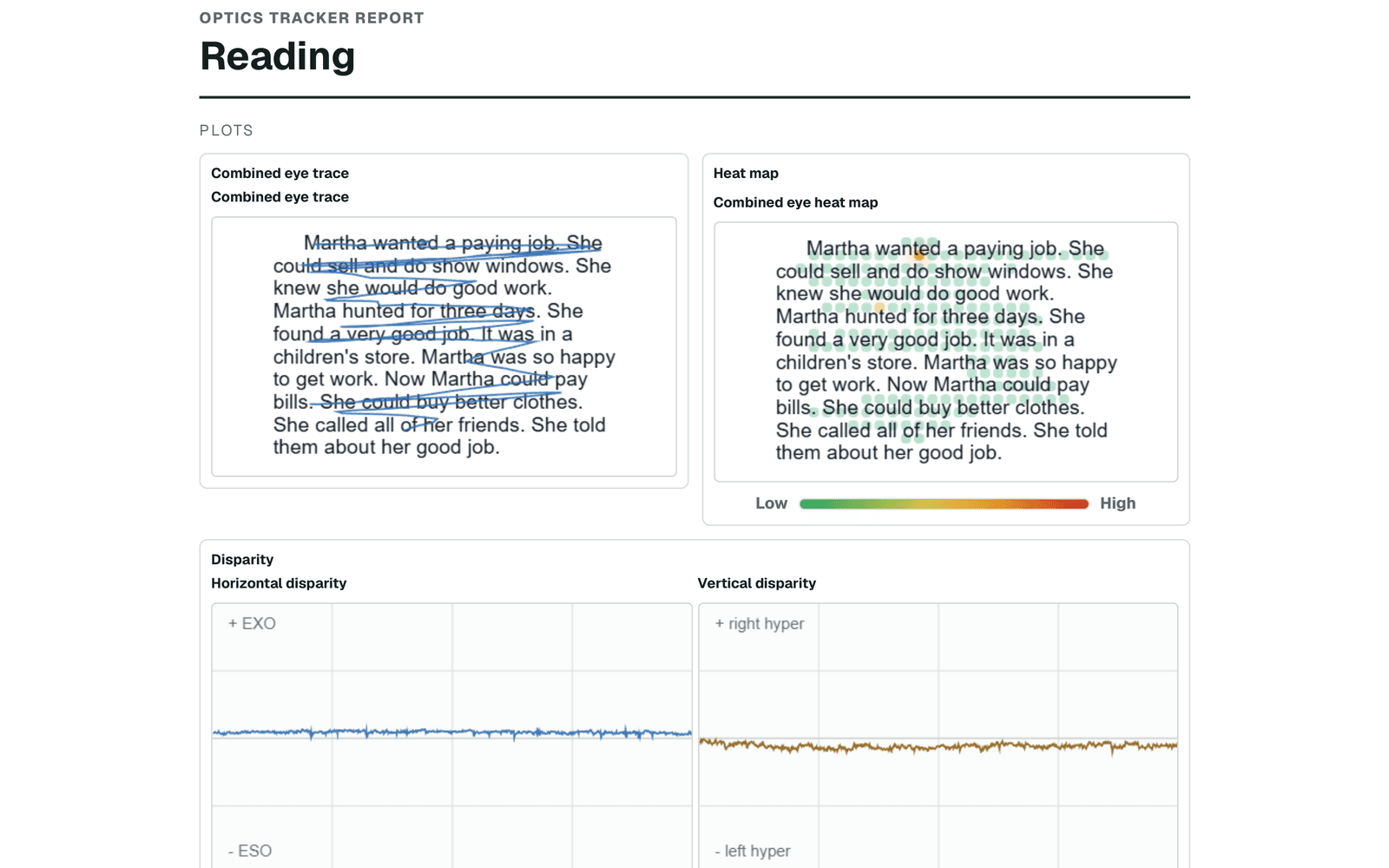
Optics Tracker's Reading Analysis replays binocular gaze across the passage and shows a combined eye trace, a heat map, horizontal and vertical disparity plots, pupil plots, and eye position over time. The report lists words per minute, comprehension, fixations and regressions (in total and per 100 words), average fixation duration, recognition span (words per fixation, which is different from the perceptual span described above) and relative efficiency for each eye, with an adjustable reading-grade norm comparison. Binocular measures include conjugacy correlation and horizontal and vertical disparity.
Optics Tracker is clinical decision-support software. Its reports support, and do not replace, professional diagnosis and clinical judgement.
Frequently asked questions
What does a reading eye tracking test measure?
It records each eye's position while the patient reads, then measures fixations, saccades, regressions, return sweeps and binocular disparity, usually with reading rate and a comprehension check.
How many regressions are normal when reading?
In skilled adult readers of English, about 10 to 15% of saccades are regressions, according to Rayner's review. Children and readers of harder text make more, so there is no single cut-off. Compare against age, passage difficulty and the norms used.
Can eye tracking diagnose dyslexia?
No. The 2009 joint statement from the AAP, AAO, AAPOS and AACO describes dyslexia as language-based. It says dyslexic readers' eye movement patterns resemble beginning readers' and appear to be a result of the reading difficulty, not its cause.
Does vision therapy improve reading comprehension?
For children with symptomatic convergence insufficiency, the CITT-ART randomised trial of 310 children found office-based vergence/accommodative therapy improved reading comprehension no more than placebo therapy over 16 weeks. The 2011 AAP, AAO, AAPOS and AACO technical report also found the evidence does not support tracking exercises, behavioural vision therapy or coloured lenses as treatments for learning disabilities.
How is a return sweep different from a regression?
A regression moves back within the text, usually to the previous word. A return sweep is the long movement to the start of the next line, and is often followed by a small corrective saccade. Counting them separately keeps regression rates accurate.
Sources
- Rayner K. Eye movements and attention in reading, scene perception, and visual search. Q J Exp Psychol. 2009;62(8):1457–1506
- Rayner K. Eye movements in reading and information processing: 20 years of research. Psychol Bull. 1998;124(3):372–422
- Rayner K. Eye movements and the perceptual span in beginning and skilled readers. J Exp Child Psychol. 1986;41(2):211–236
- Blythe HI. Developmental changes in eye movements and visual information encoding associated with learning to read. Curr Dir Psychol Sci. 2014;23(3):201–207
- Taylor SE, Frackenpohl H, Pettee JL. Grade level norms for the components of the fundamental reading skill. EDL Research and Information Bulletin No. 3. 1960
- Spichtig AN, et al. The decline of comprehension-based silent reading efficiency in the United States. Read Res Q. 2016;51(2):239–259
- Parker AJ, Slattery TJ, Kirkby JA. Return-sweep saccades during reading in adults and children. Vision Res. 2019;155:35–43
- Slattery TJ, Parker AJ. Return sweeps in reading: processing implications of undersweep-fixations. Psychon Bull Rev. 2019;26(6):1948–1957
- Parker AJ, Kirkby JA, Slattery TJ. Undersweep fixations during reading in adults and children. J Exp Child Psychol. 2020;192:104788
- Liversedge SP, White SJ, Findlay JM, Rayner K. Binocular coordination of eye movements during reading. Vision Res. 2006;46(15):2363–2374
- Blythe HI, et al. The binocular coordination of eye movements during reading in children and adults. Vision Res. 2006;46(22):3898–3908
- AAP, AAO, AAPOS, AACO. Joint statement: Learning disabilities, dyslexia, and vision. Pediatrics. 2009;124(2):837–844
- Handler SM, Fierson WM, et al. Learning disabilities, dyslexia, and vision (technical report). Pediatrics. 2011;127(3):e818–e856
- CITT-ART Investigator Group. Effect of vergence/accommodative therapy on reading in children with convergence insufficiency. Optom Vis Sci. 2019;96(11):836–849
- Ayton LN, Abel LA, Fricke TR, McBrien NA. Developmental eye movement test: what is it really measuring? Optom Vis Sci. 2009;86(6):722–730
- Maples WC, Ficklin TW. Interrater and test-retest reliability of pursuits and saccades. J Am Optom Assoc. 1988;59:549–552
- González-Vides L, Hernández-Verdejo JL, Cañadas-Suárez P. Eye tracking in optometry: a systematic review. J Eye Mov Res. 2023;16(3):3
See it in Optics Tracker