Measuring Eye Alignment: Cover Test, Krimsky and Hess Screen
Updated
Written by the Optics Trainer team from published research, with every source linked below.
Eye alignment is measured with a small family of tests: cover tests, corneal reflex tests such as Hirschberg and Krimsky, and dissociated screens such as the Hess and Lancaster. Each answers a slightly different question, and each has limits. This guide explains how the tests work, when each is used, how repeatable they are between sessions and examiners, and what studies show about newer eye-tracking and VR alternatives.
Cover tests: tropia versus phoria
EyeWiki describes cover testing as the gold-standard objective method for finding whether a misalignment is present and measuring its type and size, at 33 cm with an accommodative target and at 6 m.
- Cover-uncover comes first. If covering the fixing eye makes the other eye move to take up fixation, a tropia is present. If the covered eye drifts and then recovers when uncovered, it is a phoria.
- The alternate cover test is the most dissociating cover test and measures the total deviation, tropia plus phoria. The cover is held on each eye for a few seconds.
- The alternate prism cover test adds prisms until no movement remains. The neutralising prism power is the size of the deviation.
How repeatable cover test measurements are
For phorias in experienced hands, the alternate cover test is fairly repeatable. In one study of 72 subjects, absolute same-examiner differences in near phoria between sessions averaged about 1.3 to 1.9 prism dioptres, and absolute differences between examiners about 1.2 to 1.7. In another study, technique mattered: a longer dissociation produced larger measured deviations, by about 1 to 2 prism dioptres on average. In 20 visually normal adults, a comparison of four phoria techniques found that the low repeatability of many standard tests limits their ability to reliably detect a 4 prism dioptre difference.
In strabismus, variability is much larger. A PEDIG study of children aged 5 or younger with esotropia found that, for angles over 20 prism dioptres, two measurements could differ by about ±10 to ±12 prism dioptres; it suggested a change of 12 or more (or 6 or more for angles of 10 to 20) probably reflects real change. Another study of four examiners found variability of about ±10 prism dioptres. Changes smaller than about 6 to 12 prism dioptres, depending on the angle, may be measurement error rather than progression.
Hirschberg and Krimsky: corneal reflex tests
The Hirschberg and Krimsky tests estimate the angle from the position of the corneal light reflex, so they do not need the patient to switch fixation. That makes them useful in poorly cooperative patients, or in eyes so limited that a cover test is hard to perform.
They are less accurate than the prism cover test. In a study of experienced strabismologists using slides of four patients, every participant underestimated at least one patient by 10 prism dioptres or more with Hirschberg, and most overestimated at least one by 10 with Krimsky. In another study, Krimsky came within 10 prism dioptres of the cover test more often than software-analysed photographic Hirschberg.
Converting reflex position to an angle relies on an average Hirschberg ratio of about 20 to 22.5 prism dioptres per millimetre, which varies between people. Angle kappa, which can differ between a person's two eyes, also shifts reflex-based estimates.
Hess and Lancaster screens: mapping incomitance
Hess and Lancaster screens dissociate the eyes with red-green filters and map the deviation in nine positions of gaze, whereas cover tests usually measure only primary position. That is why they can show incomitance, a deviation that changes with direction of gaze, which a primary-gaze cover test can miss. The test depends on the patient's responses and on plotting, and one eye-tracker version of the test was described by its authors as complementary, not diagnostic on its own (Orduna-Hospital and colleagues, 2023).
Results depend on setup. In one study, the Hess screen recorded more exodeviation than the Harms screen (Hess at 0.5 m, Harms at 2.5 m), which the authors linked to the greater vergence demand at the closer distance. Results from different screens and distances need that bias taken into account.
On motility examination, in paretic deviations the eye's saccades tend to be slow, while restricted eyes move quickly up to the limit of the restriction. A severely limited eye can lead an examiner to underestimate the deviation, which is one reason Krimsky is sometimes needed.
Digital, VR and eye-tracking alternatives
Several digital alternatives have been studied, mostly in small samples:
- A digital KM screen gave results similar to Hess and Lees screens in 19 patients and was quicker to do.
- In 41 patients and 17 controls, video goggles agreed well with the Hess screen (ICC 0.76 to 0.83) and, unlike the Hess screen, could measure patients with suppression (Weber and colleagues, 2017).
- A VR Hess-Lancaster test in 52 adults with suspected or diagnosed motility disorders showed only moderate agreement with the conventional test.
- Eye-tracking cover tests in children correlated well with the prism cover test (about 0.9), but in one study the limits of agreement were about ±11.4 prism dioptres, and the device developers co-authored both studies.
- Not every system performs well: one VR cover-test prototype correlated only weakly with the prism cover test (r = 0.42).
- A 2025 meta-analysis found a pooled correlation of 0.87 between automated devices and clinical evaluation, and noted barriers before routine clinical use.
Choosing the right test
In a cooperative patient with reasonable vision in each eye, the cover test is the reference method. Corneal reflex tests are for patients who cannot do a cover test, with their wider error in mind. Hess or Lancaster mapping adds information about incomitance across gaze. Instrument-based measurements can add a recorded map, but correlation is not the same as agreement, and current evidence supports using them alongside the cover test, not instead of it.
How Optics Tracker fits
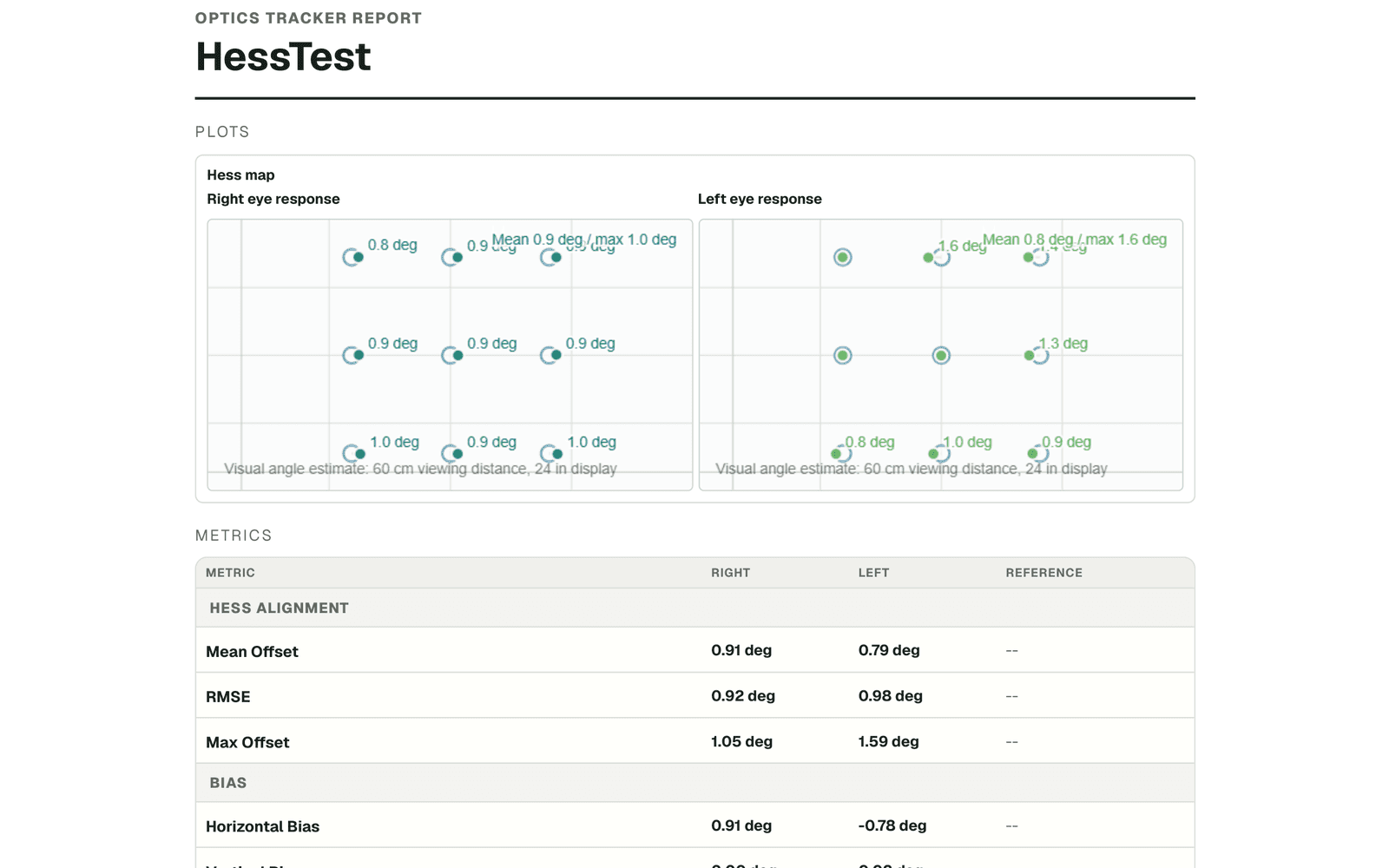
Optics Tracker includes nine-point gaze and Hess testing, with reports showing gaze maps, point accuracy, error, bias and binocular metrics. None of the studies above evaluated Optics Tracker, and their results do not apply to it.
Optics Tracker is clinical decision-support software. Its results support, and do not replace, the cover test, professional diagnosis and clinical judgement.
Frequently asked questions
What is the difference between the cover-uncover and alternate cover test?
Cover-uncover detects a manifest tropia and separates it from a phoria. The alternate cover test is more dissociating and measures the total deviation, tropia plus phoria; adding prisms quantifies it.
How accurate is the Krimsky test?
Less accurate than the prism cover test. Experienced strabismologists made errors of 10 prism dioptres or more with Hirschberg and errors of about 10 with Krimsky, though in another study Krimsky came within 10 prism dioptres of the cover test more often than photographic Hirschberg.
What does a Hess chart show?
It maps each eye's deviation across nine positions of gaze using red-green dissociation, which shows incomitance that a primary-gaze cover test can miss. It depends on the patient's responses and the test setup.
How much change in strabismus measurement is real?
Often more than a few prism dioptres. In a PEDIG study of children aged 5 or younger with esotropia, changes of 12 or more (angles over 20 prism dioptres) or 6 or more (angles of 10 to 20) were likely to be real; smaller changes may be measurement error.
Can eye tracking replace the cover test?
Not on current evidence. Eye-tracking cover tests correlated well with the prism cover test in children, but in one study the limits of agreement were about ±11.4 prism dioptres, and both studies were developer-led.
Sources
- EyeWiki (American Academy of Ophthalmology). Cover tests
- Johns HA, Manny RE, Fern K, et al. The intraexaminer and interexaminer repeatability of the alternate cover test using different prism neutralization endpoints. Optom Vis Sci. 2004;81(12):939–946
- Anderson HA, Manny RE, Cotter SA, et al. Effect of examiner experience and technique on the alternate cover test. Optom Vis Sci. 2010;87(3):168–175
- Pediatric Eye Disease Investigator Group. Interobserver reliability of the prism and alternate cover test in children with esotropia. Arch Ophthalmol. 2009;127(1):59–65
- de Jongh E, Leach C, Tjon-Fo-Sang MJ, et al. Inter-examiner variability and agreement of the alternate prism cover test (APCT) measurements of strabismus performed by 4 examiners. Strabismus. 2014;22(4):158–166
- Anstice NS, Davidson B, Field B, et al. The repeatability and reproducibility of four techniques for measuring horizontal heterophoria: implications for clinical practice. J Optom. 2021;14(3):275–281
- Choi RY, Kushner BJ. The accuracy of experienced strabismologists using the Hirschberg and Krimsky tests. Ophthalmology. 1998;105(7):1301–1306
- Tengtrisorn S, et al. The reliability of the angle of deviation measurement from the Photo-Hirschberg tests and Krimsky tests. PLoS One. 2021;16(12):e0258744
- Hasebe S, Ohtsuki H, Kono R, et al. Biometric confirmation of the Hirschberg ratio in strabismic children. Invest Ophthalmol Vis Sci. 1998;39(13):2782–2785
- Schaeffel F. Kappa and Hirschberg ratio measured with an automated video gaze tracker. Optom Vis Sci. 2002;79(5):329–334
- Orduna-Hospital E, et al. Hess Lancaster screen test with eye tracker: an objective method for the measurement of binocular gaze direction. Life (Basel). 2023;13(3):668
- Thorisdottir RL, Sundgren J, Sheikh R, et al. Comparison of a new digital KM screen test with conventional Hess and Lees screen tests in the mapping of ocular deviations. J AAPOS. 2018;22(4):277–280.e6
- Weber KP, Rappoport D, Dysli M, et al. Strabismus measurements with novel video goggles. Ophthalmology. 2017;124(12):1849–1856
- Dysli M, Fierz FC, Rappoport D, et al. Divergence bias in Hess compared to Harms screen strabismus testing. Strabismus. 2021;29(1):1–9
- Povedano-Montero FJ, et al. Conventional versus virtual reality-based Hess-Lancaster assessment: agreement and repeatability in ocular motility evaluation. J Eye Mov Res. 2026;19(3):67
- Murray AD. An approach to some aspects of strabismus from ocular and orbital trauma. Middle East Afr J Ophthalmol. 2015;22(3):312–319
- Yehezkel O, Belkin M, Wygnanski-Jaffe T. Automated diagnosis and measurement of strabismus in children. Am J Ophthalmol. 2020;213:226–234
- Zou L, Tian T, Wygnanski-Jaffe T, et al. Effectiveness and repeatability of eye-tracking-based test in strabismus measurement of children. Semin Ophthalmol. 2022;37(4):502–508
- Mori DM, Kuchhangi A, Tame J, et al. Evaluation of a novel virtual reality simulated alternate cover test to assess strabismus: a prospective, masked study. Am J Ophthalmol. 2025;269:266–272
- Hartness EM, Jiang F, Zamba GKD, et al. Automated strabismus evaluation: a critical review and meta-analysis. Front Neurol. 2025;16:1620568
See it in Optics Tracker